SEO & Paid Search
SEO vs Google Ads: Which Is Better for Small Businesses?
Compare the real trade-offs, test the economics and decide what your next marketing investment needs to achieve.
In this guide 9 sections · open contents
- What you are investing in with each channel
- SEO vs Google Ads: the practical comparison
- Compare total costs and realistic time horizons
- Buyer intent and follow-up determine lead quality
- Judge the economics beyond the cheapest click
- Which channel should get the first investment?
- When using SEO and Ads together makes sense
- A suggested 90-day testing and measurement plan
- What happens when campaigns stop?
Neither SEO nor Google Ads is universally better for a small business. The right first investment depends on your offer, competition, available budget, urgency, conversion economics and time horizon. Google Ads can put an eligible campaign in front of selected demand sooner; SEO develops the website and its organic discoverability. Both need a useful destination and a business capable of handling the enquiries.
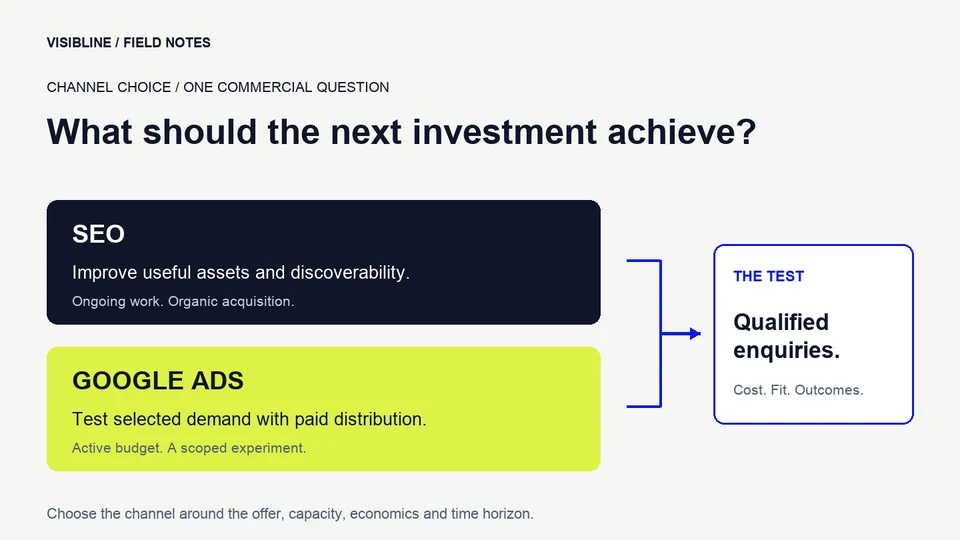
Start with the commercial constraint. Do you need to test a new service, replace an unreliable flow of enquiries, or reduce dependence on paid acquisition over time? Those are different briefs. Choosing a channel before answering that question often leaves a business paying for activity it cannot evaluate.
What you are investing in with each channel
SEO: improve the asset and its discoverability
SEO helps search engines discover and understand useful pages and helps visitors find information relevant to their search. Work can include technical corrections, service architecture, content, internal linking and the credibility of the information you publish. Organic results do not charge you for each click, but the work required to earn and maintain that visibility has a cost.
A dental practice might need clear treatment pages and an appropriate appointment route before expanding informational content. A professional services firm might need better explanations of expertise and suitability. Our SEO service covers that wider foundation rather than treating rankings as a deliverable that can be purchased.
Google Ads: buy access to eligible advertising opportunities
Google Ads includes several campaign types; this comparison concentrates on paid search. You fund a campaign that can compete to show ads for relevant demand, within its settings and eligibility. Google’s Ad Rank guidance explains that bids are only part of the assessment: quality, context and other factors also matter. The highest budget does not automatically buy every placement.
The website still matters after the click. An ad for a specific roofing repair should lead to a useful repair page, not an unrelated gallery or a general promise to “do everything”. Better alignment gives the visitor a clearer decision; it does not remove the need to qualify the enquiry.
SEO vs Google Ads: the practical comparison
Use this table to identify the trade-offs. It describes how the channels work, not fixed prices, guaranteed timings or a forecast for your business.
| Decision factor | SEO | Google Ads: paid search |
|---|---|---|
| Speed to initial traffic | Depends on the starting site, indexing and competition; meaningful gains may take time. | Can reach selected demand after approval and setup; profitable performance is a separate test. |
| Upfront investment | Audit, technical priorities, service pages, content and measurement. | Campaign design, tracking, suitable landing pages and an initial media budget. |
| Ongoing costs | Maintenance, new information, technical support and continued improvement. | Media spend, management, creative or page updates and measurement. |
| Targeting control | You shape relevance and coverage, but cannot select every searcher or organic placement. | More direct campaign controls; actual delivery still depends on settings, demand and eligibility. |
| Sustainability | Useful assets can continue attracting visits, with no guarantee of stable positions. | Ad delivery depends on active, funded campaigns; pausing removes that paid distribution. |
| Scalability | Constrained by useful demand, competition, content quality and implementation capacity. | Constrained by demand, auctions, budget, conversion performance and delivery capacity. |
| Attribution | Connect organic visits to enquiries and outcomes; some journeys remain incomplete. | Campaign reporting offers more direct spend data, but tracking and lead definitions still need scrutiny. |
| Long-term benefits | Stronger pages, useful content and a more discoverable website. | Test evidence about messages, demand and pages, plus ongoing paid acquisition when economics support it. |
| Suitable situations | A longer horizon, durable information needs and the ability to improve the site. | A defined offer, a usable page, sufficient test budget and a need to assess demand sooner. |
Compare total costs and realistic time horizons
Ask what the budget includes. An SEO fee may exclude development work, expert review or photography. An Ads management fee may exclude media spend, landing pages or call handling. A cheaper quote is not automatically a cheaper way to acquire a suitable customer when important work sits outside the scope.
Separate setup from ongoing operation. A business with an unclear offer and a broken enquiry form needs those problems addressed whichever channel it chooses. Once that foundation is usable, SEO and paid search may require different production schedules and cash commitments.
Google notes that search improvements can take time to be reflected, with effects varying from days to months in its guidance on evaluating website improvements. That is not a promised SEO schedule. Ads can begin serving sooner once eligible, but fast traffic should not be confused with proven lead quality or profitability.
Buyer intent and follow-up determine lead quality
A paid click is not inherently a poor lead, and an organic visitor is not inherently ready to buy. Someone searching for an emergency roofer has a different need from someone comparing roof types for a future renovation. Either channel can reach an unsuitable enquiry if the message, service area or destination is unclear.
For a dental clinic, a treatment enquiry may still require an assessment of suitability and availability. For an aesthetic clinic, transparent consultation information matters more than a headline promising an outcome. Our aesthetic clinic marketing guide explains that considered consultation journey.
Include the receiving team in the measurement. Are calls answered? Does someone respond to forms? Can staff identify which enquiries match the service? A campaign cannot compensate indefinitely for a slow or confusing response process. Fixing that handoff can be more useful than switching channels.
Judge the economics beyond the cheapest click
Use cost per qualified lead alongside cost per enquiry. Define “qualified” in terms the business can apply consistently: a relevant service, real coverage, practical timing and an appropriate next step. Then record whether the enquiry becomes an appointment, quotation or customer.
A hypothetical example, not a benchmark
Suppose a business spends £1,200 on acquisition, including the campaign and the agreed supporting costs. It receives 20 enquiries, of which eight meet its qualification criteria. Cost per enquiry is £60; cost per qualified lead is £150. If two become customers, acquisition cost is £600 per customer.
If each customer contributes £400 after the direct cost of delivery, the two customers contribute £800 against £1,200 of acquisition cost. That test does not break even on the assumed first purchase. Repeat work could change the decision, but it must be evidenced rather than added to rescue the story.
Apply the same discipline to SEO. Include the agreed production and implementation costs over an appropriate evaluation period instead of calling organic acquisition free. Where useful assets support several channels, document a reasonable allocation rather than assigning the same cost twice.
Google’s conversion measurement guidance describes tracking actions after ad interactions. Your business must still decide which actions indicate value. A button click, a submitted form and an accepted job are different stages, and incomplete consent or attribution can limit what the reports show.
Which channel should get the first investment?
Use a sequence of decisions instead of a universal budget split. Do not divide a small budget across several activities if none receives enough attention to produce interpretable evidence.
- Confirm the offer. Identify a specific service, suitable customer, coverage and available capacity. If these are unclear, invest in the brief and destination first.
- Check the website. Repair major access, information and enquiry problems before paying to send more people to them.
- Define the economic boundary. Estimate the contribution from a customer and agree an affordable test loss. Do not use revenue alone as the spending limit.
- Choose the time horizon. If you need a near-term demand test and can fund it responsibly, paid search may be the clearer first experiment.
- Assess the durable opportunity. If customers repeatedly research your service and the website needs substantial improvement, SEO may be a better first foundation.
- Choose one primary learning goal. Agree what evidence would justify continuing, changing or stopping the work.
A professional services provider with a considered buying cycle may prioritise useful expertise and service pages before broad advertising. A roofer with a clear repair offer, working intake and spare capacity may choose a tightly scoped paid-search test. Neither example establishes the right answer for every firm in that sector.
When using SEO and Ads together makes sense
A combined approach can be useful when the activities have distinct jobs. Paid search might test a defined service offer while SEO improves the relevant pages and addresses recurring research questions. Both can share accurate service information and a reliable enquiry process without pretending they reach identical audiences.
For a dental practice, an agreed campaign may assess demand for one treatment while the wider website explains care and practitioner information. For a roofing company, repair and replacement journeys may need separate priorities. Avoid sending every visitor through one generic page simply because both channels are active.
Review overlap as well as combined totals. A branded ad campaign might capture searches that would also have found the business organically. Ask what the paid activity adds, where attribution is uncertain and what happens when the mix changes. A connected marketing strategy should assign each channel a purpose rather than assume that more channels mean more growth.
A suggested 90-day testing and measurement plan
This is a planning framework, not a minimum contract or a promise that every SEO investment can be judged conclusively in three months. Extend the evaluation where buying cycles or implementation constraints require it.
- Days 1–30: establish a trustworthy starting point. Agree one priority offer, qualification rules, capacity and budget boundaries. Inspect current search performance, landing pages and enquiry handling. Check measurement with controlled, authorised tests before relying on the reports.
- Days 31–60: deliver the agreed primary work. Implement the selected website priorities or run the scoped paid-search test. Record changes and review actual questions or search terms where available. Correct irrelevant targeting, unclear information and response bottlenecks.
- Days 61–90: review commercial evidence. Compare suitable enquiries, customer outcomes, total acquisition costs and operational feedback. Separate observations from attribution assumptions. Continue, adjust or pause the activity against the agreed boundaries, and set the next review date.
What happens when campaigns stop?
When you pause or stop funding an Ads campaign, it no longer provides that paid distribution. It does not follow that all business enquiries disappear: organic search, referrals and other channels may still contribute. Make dependence visible so the team understands what the campaign is supporting.
SEO assets can remain useful after a project ends, but they require maintenance. Services change, links break, competitors improve and information becomes outdated. A page that once answered a customer’s question can become inaccurate. Organic visibility is not a permanent entitlement secured by a one-off optimisation exercise.
Before committing to either channel, ask what will be delivered, what the business must provide, how results will be evaluated and who owns the accounts and assets. The better investment is the one with a credible business case and a scope your team can actually support.
Choose the channel around the business case.
Not sure whether SEO, Google Ads or a combined approach should come first? Visibline can review your market, existing visibility and enquiry journey to help prioritise the work.
Get a Free Marketing Strategy Review