GEO & AI Search
How to Get Your Business Found in ChatGPT and Google AI Search
Separate citations from recommendations, strengthen the evidence behind your business and build a responsible AI visibility plan.
In this guide 11 sections · open contents
- A search result, a citation and a recommendation are different
- ChatGPT, Google AI search and Perplexity use different systems
- Traditional SEO remains part of the foundation
- Make the business and its services unambiguous
- Publish useful evidence that you can stand behind
- Check access and structured data without chasing shortcuts
- Reputation and local context need independent evidence
- AI Visibility Audit Checklist
- A practical 30-day improvement roadmap
- Measure AI visibility without fooling yourself
- When professional support makes sense
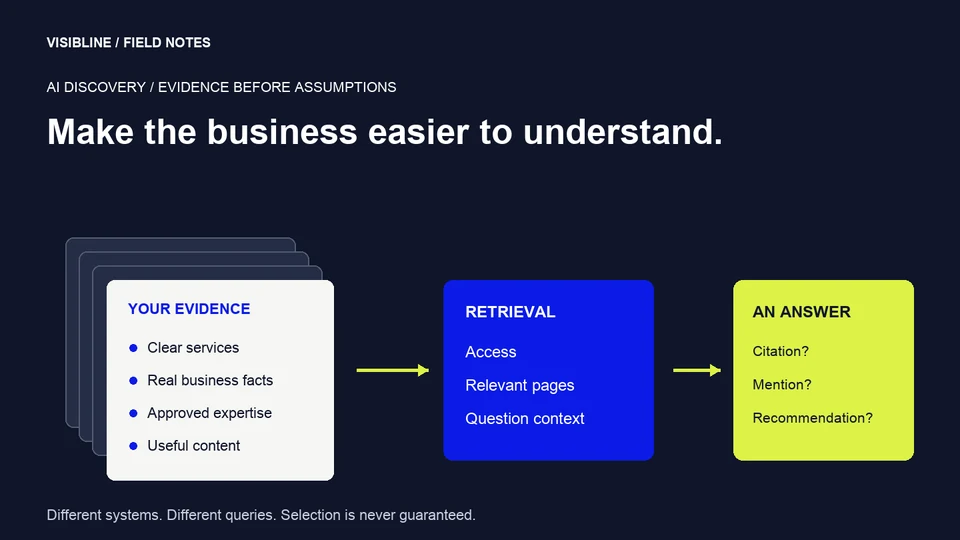
To help your business get found in ChatGPT and Google AI search, make the business easy to identify, its useful information easy to retrieve, and its claims easy to verify. Keep improving traditional SEO, publish clear service information and remove technical access problems. These steps support discovery; they do not guarantee a citation, a mention or a recommendation.
A prospective customer can ask an assistant to explain a treatment, compare local contractors or shortlist professional advisers. The response may draw on several sources and change when the question changes. Your job is to make accurate evidence available at the points where the customer needs it, rather than chase a single universal “AI ranking”.
A search result, a citation and a recommendation are different
A traditional search result offers a route to a page. An AI citation identifies a source used or linked in an answer. A brand mention names a business, while a recommendation suggests it as an option for a particular need. Those outcomes can overlap, but they are not interchangeable.
A dental practice’s guide might be cited to explain appointment preparation without the practice being recommended to a patient. A law firm might be named in a comparison without a link. A roofing company might receive a visit from a conventional result while never appearing in the accompanying AI response. Decide which outcome you are measuring before declaring success.
This distinction also improves briefs. “Get us into AI” is hard to evaluate. “Make our commercial maintenance service accurately discoverable, then check whether relevant answers identify it correctly” gives the work a clear subject, evidence requirements and an observable test.
ChatGPT, Google AI search and Perplexity use different systems
ChatGPT can answer using different information pathways depending on the experience and request; search-enabled answers can retrieve web information. OpenAI’s crawler documentation distinguishes OAI-SearchBot, which supports search, from GPTBot, which concerns model-training crawls. The settings are independent. Allowing a training crawler is not a substitute for search accessibility, and access is not an editorial endorsement.
Google AI Overviews and AI Mode are features within Google Search. Google states that established SEO practices still apply and that no special AI markup is required. Its AI features guidance describes eligibility and technical considerations. Do not assume that a conventional high position means the same page must be selected for every generated answer.
Perplexity publishes its own crawler guidance, including PerplexityBot for surfacing websites in search results and a separate user-initiated agent. Treat each platform’s access controls separately. A single robots rule or visibility check does not establish how every assistant will discover and use your information.
Traditional SEO remains part of the foundation
A page that search systems cannot discover or understand is a weak foundation for AI visibility work. Keep important pages linked from the website, give them a clear purpose, and ensure their main information exists as accessible text. A business owner should be able to describe what each page helps a customer decide.
Useful content does not have to become a collection of robotic questions and answers. A well-structured service page can explain scope, suitability, process, limitations and the next step. An article can resolve a specific question and then point to a relevant service when the reader needs implementation help. Our SEO work addresses that underlying discoverability and page structure.
Keep ownership clear between the two. An informational guide about a leaking roof should help someone understand the issue; a roofing service page should explain the actual work and coverage offered. Publishing several pages with the same commercial pitch under different AI-related titles creates confusion rather than a stronger evidence base.
Make the business and its services unambiguous
State the trading name, real contact route, actual service coverage and the services you provide in plain language. Explain who the offer is for and where its limits sit. If a service is available only to commercial clients, say so. If a clinic offers consultations before determining suitability, make that sequence clear.
For a law firm, practice areas, jurisdiction and the appropriate first-contact route need to be understandable without an assistant making assumptions. For a home services business, “we cover the region” is less useful than an accurate explanation of repair coverage, planned installation coverage and exclusions. Clarity helps people as well as retrieval systems.
Review important third-party profiles for material inconsistencies. A former address or an old service description can complicate research. Correct genuine errors on the website and relevant independent records; do not create fictional offices or unsupported credentials to produce more mentions.
Publish useful evidence that you can stand behind
Original usefulness can come from explaining a decision properly. A clinic could describe what an initial consultation involves and what information a patient should bring. A dentist could explain how treatment suitability is assessed, with appropriate clinical review. Neither needs to invent a dramatic outcome or disclose private patient details.
A contractor could show an approved project with the real scope, constraints and their own role. A professional adviser could explain the documents needed for an initial assessment, while making the boundaries of general information clear. These examples provide something more substantial than another generic article promising that a service is “the best”.
Keep responsibility for factual approval explicit. Record who supplied the information, when it was checked and what evidence supports a claim. Do not add invented experiments, synthetic customer quotations or unverified success figures. Visibline’s content service can support that briefing and production process without substituting confident language for proof.
Check access and structured data without chasing shortcuts
Inspect robots rules, page-level indexing instructions, canonical URLs, response codes and important internal links. A developer should also check whether hosting or security controls block legitimate retrieval. Avoid weakening protection for everyone: diagnose the specific access issue and use the platform’s published identification guidance where appropriate.
Read the page without relying on a carousel, a login or an elaborate client-side interaction. Can a visitor reach the main service explanation and contact details? Essential content should not depend on a hidden interface that provides no useful HTML when it fails.
Structured data can describe visible entities and page information in a machine-readable form. It must match the page and use appropriate types. It cannot establish expertise that the content does not demonstrate, and it does not purchase a citation. Google’s structured data introduction explains its role in helping Search understand page content.
There is no universal AI-specific schema that guarantees inclusion. Likewise, publishing llms.txt is not evidence that an assistant will retrieve, trust or recommend a business. If you experiment with additional files, label the work as an experiment and keep it separate from the fundamentals and from promises made to clients.
Reputation and local context need independent evidence
Relevant third-party references can give a researching customer another way to verify a business. Consider legitimate professional registers, accurate industry directories, appropriate memberships and independent coverage where they genuinely apply. The objective is corroboration, not a bulk order of paid praise.
Local discovery also depends on the facts of the requested service. A person asking for an accessible dental practice has different criteria from a procurement manager seeking a commercial maintenance provider. Make the practical information available: real coverage, access arrangements, appointment or assessment process and a working response route.
Do not turn that into a guaranteed AI ranking formula. A citation to a third-party directory may reflect the particular answer’s needs, while another answer cites a service page. Evaluate accuracy and relevance across a defined set of questions rather than trying to recreate one isolated response.
AI Visibility Audit Checklist
Use this as an evidence checklist. “Yes” should point to a page, a verified record or a documented test, rather than an assumption about what an AI system knows.
- Identity: Can a reader identify the real business and distinguish it from similarly named organisations?
- Offer: Are the service, audience, coverage and exclusions explicit?
- Access: Do priority pages return successfully, remain crawlable where intended and expose useful HTML?
- Evidence: Do claims have appropriate support and an accountable approval process?
- Page ownership: Does each important customer question have a clear, useful destination?
- Consistency: Do important external records agree on material business facts?
- Markup: Does structured data accurately describe the visible page?
- Measurement: Are citations, mentions, referral visits and suitable enquiries recorded separately?
A practical 30-day improvement roadmap
This is a proposed work plan, not a promise that AI visibility will change within a month. Adjust the scope to the business, approval requirements and development capacity.
- Days 1–7: establish the facts. Agree the priority services and customers. Record a small set of real research questions, review current answers and save the date, platform, query and cited sources. Audit the corresponding website pages.
- Days 8–14: repair the foundations. Resolve important access and indexing mistakes. Correct material business inconsistencies and improve the highest-priority service explanation before commissioning more articles.
- Days 15–21: add useful evidence. Publish or improve a genuinely helpful guide, approved project explanation or service decision resource. Link it into the relevant journey and check its accuracy with the business.
- Days 22–30: repeat and interpret. Re-run the documented questions, check referrals and review enquiry feedback. Record what changed, what did not and what remains uncertain. Choose the next work from that evidence.
Measure AI visibility without fooling yourself
Keep the test conditions with every observation: platform or mode, exact prompt, date, location context where relevant, and whether a link, citation or unlinked mention appeared. Ask commercially meaningful questions, not only prompts designed to produce your brand name. Repeating a test helps reveal how variable the result is.
Google reports traffic from its AI search features within overall Search Console web performance, rather than providing a complete, separate citation ledger. Website analytics can identify some assistant referrals, but an answer that sends no visit will not appear as a referral session. No single report captures the whole journey.
Keep organic search performance, sampled answer visibility, referral traffic and commercial outcomes distinct. A saved response is evidence of that response at that time; it is not a market-wide share-of-voice statistic. Ask whether the resulting enquiries are relevant before increasing activity based on mentions alone.
When professional support makes sense
Get help when the work crosses editorial, technical and commercial responsibilities that nobody currently owns. An agency should explain the evidence it will gather, which pages and records it will improve, and how the business will approve claims. Expect a scope and a review method, not guaranteed placement inside an assistant.
Be wary of promises that one schema plugin, a file upload or a fixed quantity of AI-written content will secure recommendations. A useful programme makes accurate information easier to discover and evaluate, then tests its assumptions. That remains valuable even when individual AI answers change.
Understand where your business can be discovered.
Your customers research through search engines and AI assistants. Visibline can review technical access, service clarity and available evidence, then prioritise useful improvements.
Request a Free Visibility Review